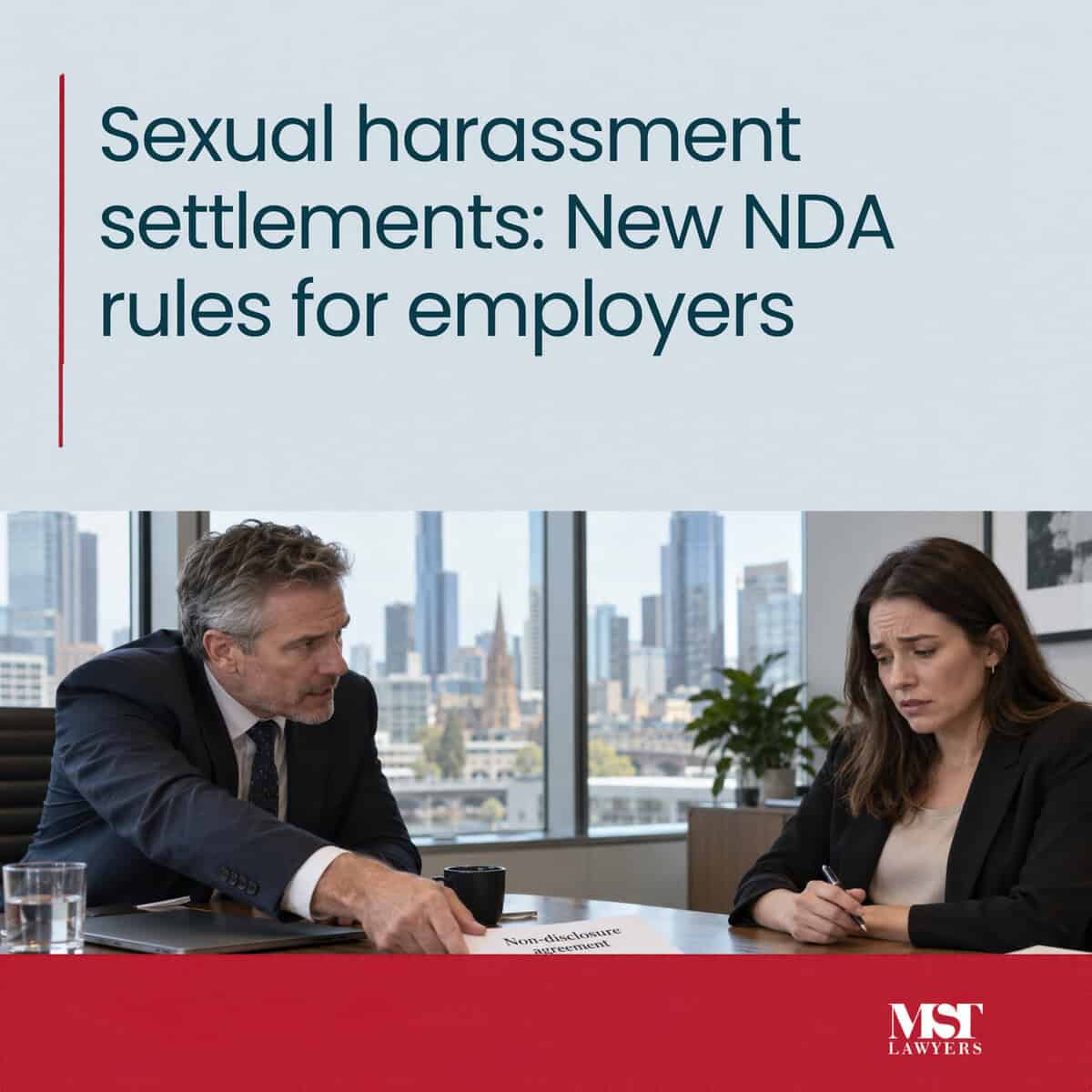
In an Australian first, the Victorian Labor Government introduced the Restricting Non-disclosure Agreements (Sexual Harassment at Work) Bill 2025 to Parliament on 29 October 2025. The Bill seeks to significantly restrict the use of non-disclosure agreements in the settlement of workplace sexual harassment matters.
What are non-disclosure agreements?
Non-disclosure agreements (‘NDAs’) are contracts that prevent the parties involved from disclosing information to third parties. While traditionally used to protect trade secrets, NDAs are increasingly used in out-of-court settlements of workplace sexual harassment complaints.
This practice has drawn criticism that NDAs may prevent victim-survivors from speaking about their experiences, contributing to what Premier Jacinta Allan has described as a ‘culture of secrecy, enabling perpetrators to reoffend [and] letting employers avoid action to prevent sexual harassment in their workplaces’.
The Restricting Non-disclosure Agreements (Sexual Harassment at Work) Bill 2025 (‘the Bill’) limits the use of NDAs in workplace sexual harassment matters by regulating:
- the circumstances in which NDAs may be entered into
- the terms that may be included in an NDA
- when NDAs are enforceable
Key changes proposed by the Bill
If passed, the Bill will prohibit NDAs in workplace sexual harassment settlements unless the complainant employee expressly requests one.
Other proposed changes include:
- Mandatory review period: If a complainant requests an NDA, employers must provide a minimum 21-day review period before the agreement is finalised.
- Information statement: Employers must give the complainant a workplace non-disclosure agreement information statement before entering into an NDA.
- No undue influence: Employers must not exert pressure or undue influence on the complainant regarding whether to request or enter into an NDA.
- Plain-language requirement: NDAs must be written in clear, accessible language.
- Disclosure rights protected: NDAs cannot prevent disclosure to certain parties, including lawyers, prospective employers, police, the Australian Human Rights Commission and the Fair Work Commission.
- Right to terminate: Complainants may elect to terminate an NDA after it has been in operation for one year.
- Limits on NDAs for respondent employees: The Bill restricts the use of NDAs or non-disclosure terms in employment contracts with respondent employees to prevent the concealment of material information about workplace sexual harassment.
What this means for employers
The Bill reinforces the increasing legal and societal expectation that employers take proactive, positive steps to prevent workplace sexual harassment.
If enacted, the reforms will significantly affect how Victorian employers respond to and manage sexual harassment complaints. Employers should ensure they have a strong framework to minimise risk, including:
- clear and enforceable workplace sexual harassment policies
- regular and meaningful training for employees
- robust reporting mechanisms and complaint-handling procedures
- careful consideration of how settlement discussions are conducted
MST Lawyers can assist businesses in meeting their positive duty obligations and ensuring their workplace practices remain compliant.
Speak to our Workplace Relations team
For support with reviewing policies, updating procedures or managing workplace sexual harassment matters, contact our Workplace Relations team for practical advice tailored to your business.
Key takeaways
- The Victorian Government has introduced a Bill that would significantly restrict the use of NDAs in workplace sexual harassment settlements.
- NDAs will be banned unless requested by the complainant employee.
- The Bill introduces strict requirements for NDAs, including review periods, information statements, disclosure rights and a right of termination.
- Employers must ensure they have strong preventative frameworks and compliant processes for managing sexual harassment complaints.
People also ask (FAQs)
Are NDAs still allowed in workplace sexual harassment cases in Victoria?
Under the proposed Bill, NDAs will only be permitted if the complainant employee specifically requests one.
Can an NDA prevent someone from reporting sexual harassment to authorities?
No. The Bill prohibits NDAs from restricting disclosure to lawyers, police, prospective employers, the Australian Human Rights Commission and the Fair Work Commission.
What should employers do now?
Employers should review their policies, training, complaint-handling procedures and settlement practices to ensure they align with the proposed requirements.