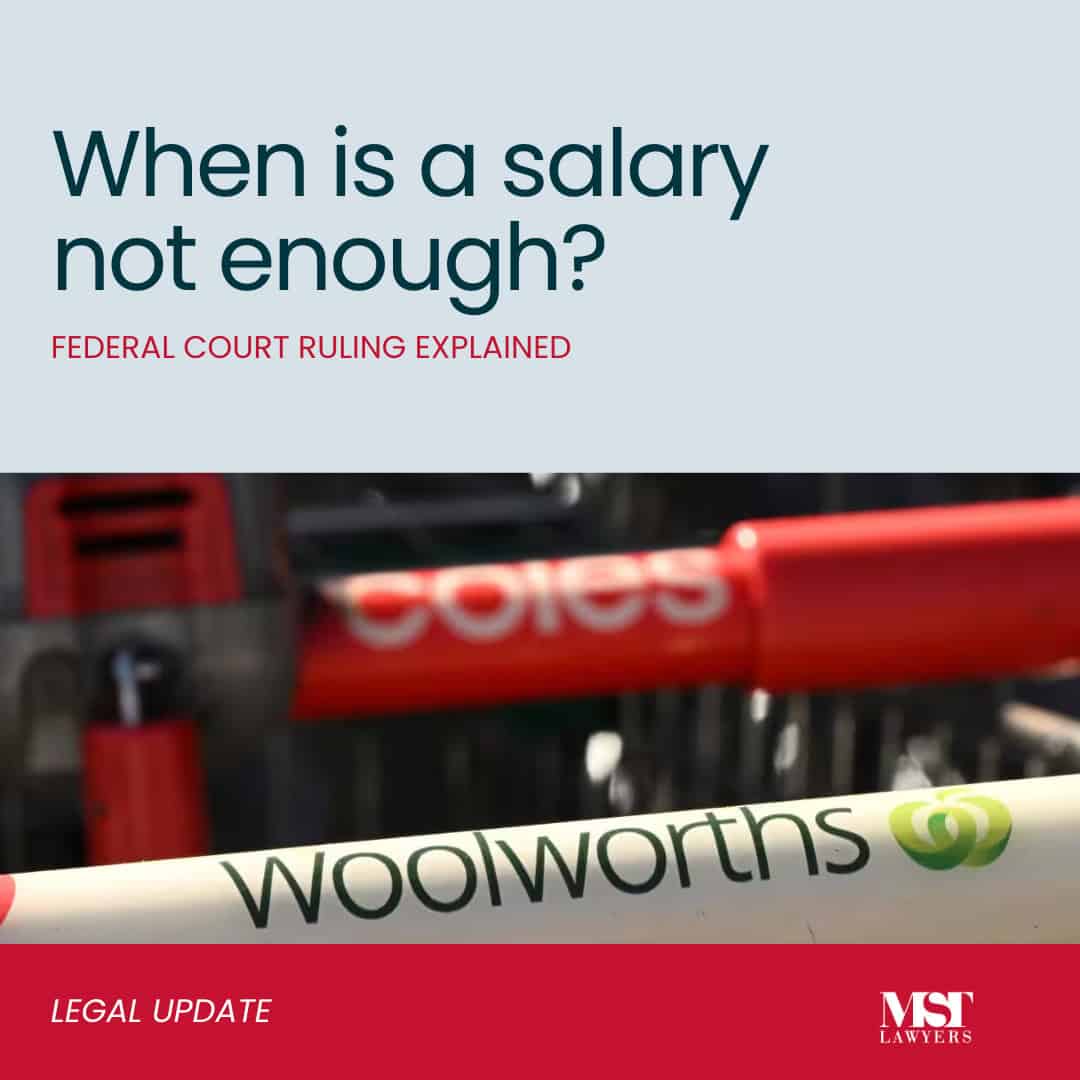
Summary: The recent Federal Court decision against Coles and Woolworths has determined that employers who pay annual salaries must still comply with each employee’s minimum entitlements in each pay cycle.
Background: Coles and Woolworths case
In 2021, the Fair Work Ombudsman (FWO) brought cases against Coles and Woolworths in the Federal Court in relation to significant alleged underpayments made to their salaried managerial employees.
It was alleged that the underpayments arose because the salaries paid to employees were not sufficient to cover overtime and penalty rates, along with other entitlements under the General Retail Industry Award, despite the existence of a set off clause in the employees’ employment agreements.
What is a set off clause?
Set off clauses are commonly included in employment agreements to allow employers to offset payments made to an employee in excess of the applicable base rate of pay against obligations arising under modern awards or enterprise agreements (for example overtime, penalty rates, allowances and annual leave loading).
The Federal Court’s decision
In examining the Fair Work Act 2009 (Cth), Justice Perram confirmed that employers are obligated to pay an employee ‘in full’ amounts payable in relation to the performance of work.
Key findings from Justice Perram
An employment agreement provides an obligation on the employer to pay a periodic instalment of the annual remuneration.
The General Retail Industry Award additionally imposed a requirement on employers to pay wages on either a weekly or fortnightly basis.
The language of the Award required that wages and overtime be ‘paid’. Any monetary obligations arising under the award were obligations to pay and could only be discharged by a payment.
The Fair Work Act requires amounts which are payable to an employee to be paid “in full”. Where a payment is made under a contractual provision to discharge an employer’s obligation to pay an employee’s entitlements, but is less than the value of the entitlements, this would be in breach of the Fair Work Act. See Fair Work Ac t (2009) Section 323(1) here.
Whilst the set off clause resulted in an ‘accounting abstraction’ which could potentially be valid under contract law, this did not result in a payment being made and could not discharge any payment obligations due under the General Retail Industry Award.
Impact on employers
Although the judgement was based on a 2010 iteration of the General Retail Industry Award, the legislative interpretation principles apply across all modern awards and many enterprise agreements.
Employers who pay annualised salaries close to the award minimums may now need to consider moving towards hourly payments rather than fixed salaries. This decision may also reduce flexibility around ad hoc time off in lieu arrangements (for example, “you stayed back tonight so don’t come in until tomorrow afternoon”).
Compliance steps for employers
To comply with the decision, employers must now:
- Ensure that employees are paid ‘in full’ in each pay cycle for the work completed (regardless of what has transpired in the previous weeks).
- Ensure robust record-keeping processes are in place for all employees, including salaried employees, to avoid inadvertent underpayments.
- Consider whether they can extend the pay cycle for salaried employees to allow greater flexibility for salaries to balance out entitlements.
Whilst it is expected this decision will be appealed, it is likely that the FWO and unions will be actively seeking underpaid salaried employees.
How MST Lawyers can help
MST Lawyers’ Employment Law team can assist with:
- Reviewing employment agreements, including set off clauses.
- Advising on compliance with the Fair Work Act and relevant modern awards.
- Auditing payroll and record-keeping systems to minimise the risk of underpayments.
For tailored advice, contact our Employment Law team on (03) 8540 0200 or email employmentlaw@mst.com.au.
Key takeaways
- Employers must ensure annual salaries comply with minimum entitlements in every pay cycle.
- Set off clauses in employment contracts cannot replace actual payment of entitlements.
- The ruling impacts all modern awards and many enterprise agreements, not just retail.
- Employers close to award minimums may need to shift from annualised salaries to hourly pay.
- Robust payroll and record-keeping processes are essential to avoid underpayments.